A Dead Partner and a Frozen Soul
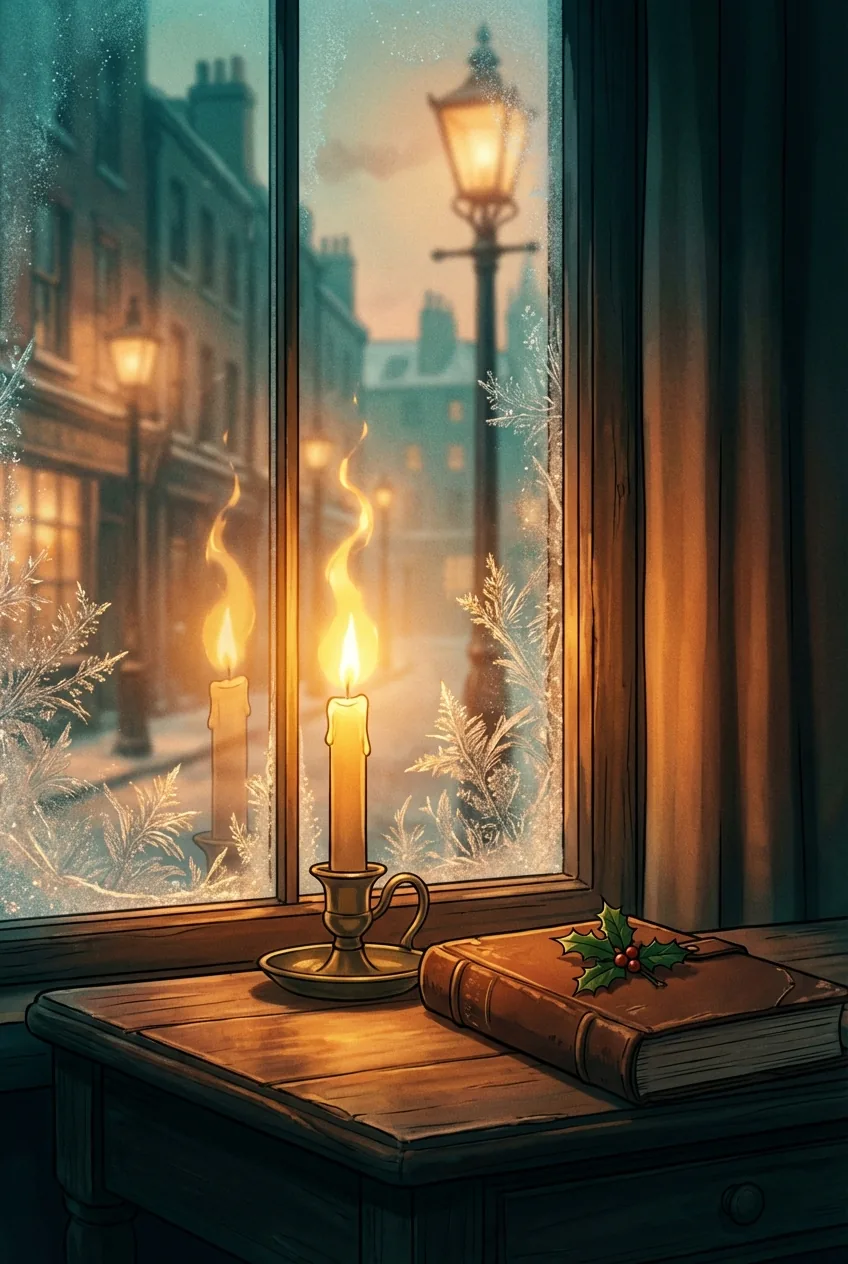
Marley was dead—let there be no mistake about that. Dead as a door-nail, if one may be permitted the expression, though I confess the particular deadness of door-nails remains something of a mystery, and perhaps coffin-nails might serve better. But no matter; the point must be established with emphatic certainty, for without the absolute conviction of Marley's demise, nothing wonderful can proceed from what follows. The register bore all the necessary signatures—clergyman, clerk, undertaker, and chief mourner—and that chief mourner was none other than Ebenezer Scrooge himself, Marley's sole executor, sole administrator, sole assign, sole residuary legatee, sole friend, and sole anything else one might name. So dreadfully affected was Scrooge by this sad event that he managed to conduct an undoubted bargain on the very day of the funeral.
Oh! But what a piece of work was Scrooge! A squeezing, wrenching, grasping, scraping, clutching, covetous old sinner—hard and sharp as flint, secret and self-contained and solitary as an oyster. The cold within him had frozen his features blue and red in all the wrong places, had stiffened his gait and sharpened his grating voice. He carried his own low temperature about with him perpetually, icing his office in the dog-days and refusing to thaw it one degree at Christmas. No warmth could warm him, no wind could out-bitter him, no falling snow was more intent upon its purpose. Even the blind men's dogs knew him by some canine instinct and tugged their masters into doorways at his approach.
It was Christmas Eve, and old Scrooge sat busy in his counting-house while the fog pressed in at every chink and his poor clerk Bob Cratchit shivered over a fire so meager it resembled one coal. Into this frozen domain burst Scrooge's nephew Fred, all ruddy warmth and sparkling eyes, offering dinner invitations and holiday blessings—and receiving nothing but "Bah! Humbug!" and a succession of icy "Good afternoons!" in return. Two charitable gentlemen fared no better, retreating in dismay after Scrooge inquired whether prisons and workhouses were still in operation and declared that those who would rather die than enter them had better do it and decrease the surplus population.
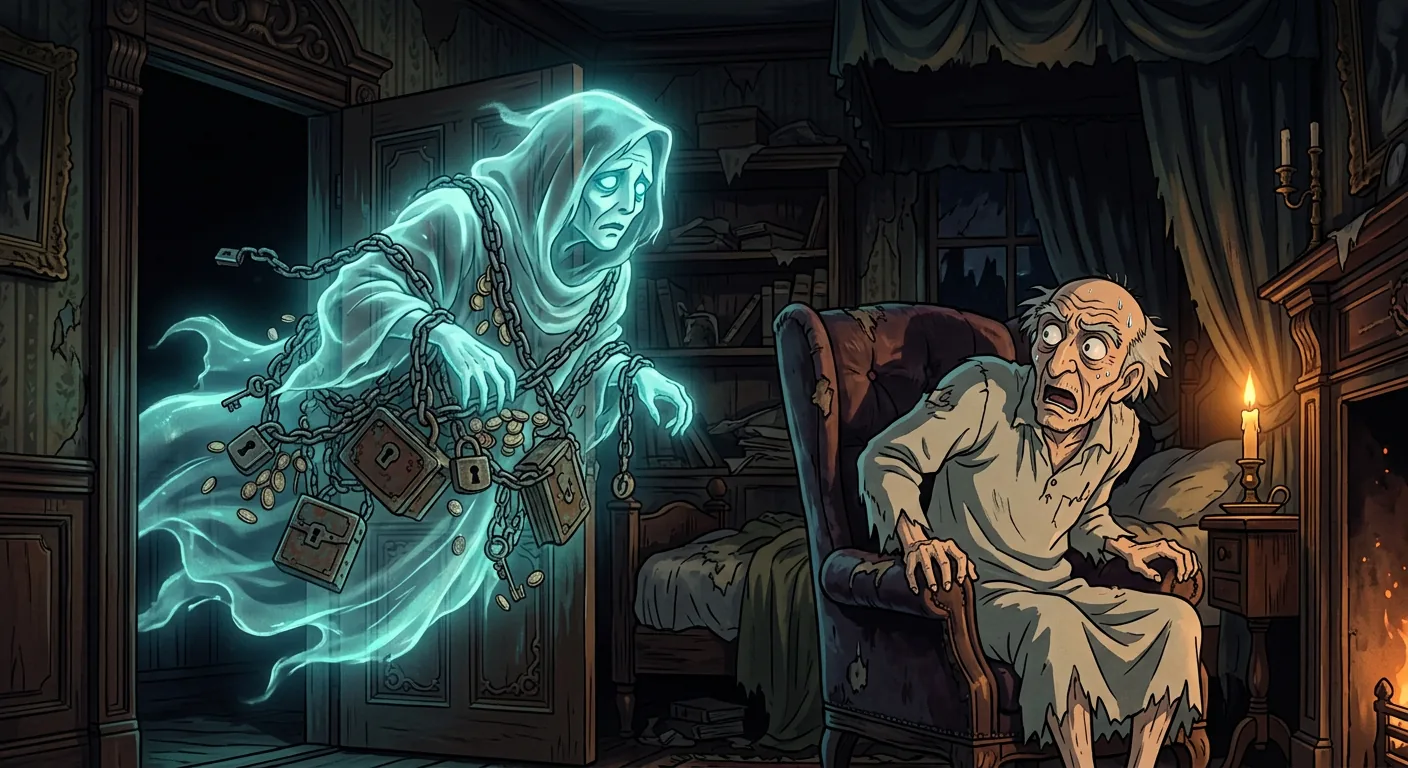
That night, having taken his melancholy dinner and retired to his chambers—those gloomy rooms that had once belonged to Marley himself—Scrooge beheld a most extraordinary sight: the door-knocker transformed, briefly but unmistakably, into the face of his dead partner, complete with ghostly spectacles. He dismissed it, naturally, with a "Pooh, pooh!" and climbed the stairs. But dismissal proved insufficient, for presently every bell in the house began to ring, chains clanked in the cellar, and through the heavy door came Marley's Ghost itself—transparent, fettered with a ponderous chain wrought of cash-boxes and ledgers and heavy purses, condemned to wander the world witnessing what it could no longer share.
"I wear the chain I forged in life," the spectre moaned, and warned Scrooge that his own chain had grown equally long in the seven years since Marley's death. Mankind, the Ghost declared, should have been his business—charity, mercy, forbearance, and benevolence. Now, too late, he wandered in torment. But hope remained for Scrooge: he would be visited by Three Spirits, the first when the bell tolled One.
As the phantom floated out into the dark night, Scrooge glimpsed the air filled with wandering spectres, all chained, all moaning with the misery of wanting to help the living and having lost the power forever. Then silence returned, and Scrooge, exhausted by emotion or fatigues or his glimpse of the Invisible World, fell into bed without undressing and slept upon the instant—though what dreams might come with the tolling of the bell remained yet to be discovered.
The Ghost of Christmas Past Arrives
When Scrooge awoke to find the darkness so complete that he could scarcely distinguish window from wall, the neighboring church bells set about confounding him utterly. They struck twelve—twelve!—when it had been past two when he had sought his bed. His repeater confirmed the impossible hour, and so Scrooge was left to grapple with the preposterous notion that either he had slept through an entire day and into another night, or else something catastrophic had befallen the sun itself. This latter idea proved most alarming, for "three days after sight of this First of Exchange pay to Mr. Ebenezer Scrooge" would become mere worthless paper if there were no days left to count by.
He thought, and thought, and thought it over—and could make nothing of it. Marley's Ghost bothered him exceedingly. Each time he resolved that it had been merely a dream, his mind flew back again, like a strong spring released, to the selfsame question: Was it a dream or not?
He remembered then the Ghost's warning of a visitation when the bell tolled one, and resolved to lie awake until the hour was passed—considering that he could no more go to sleep than go to Heaven, this was perhaps the wisest resolution in his power. The quarter-hours crept by with maddening deliberation until at last the bell sounded with a deep, dull, hollow, melancholy ONE.
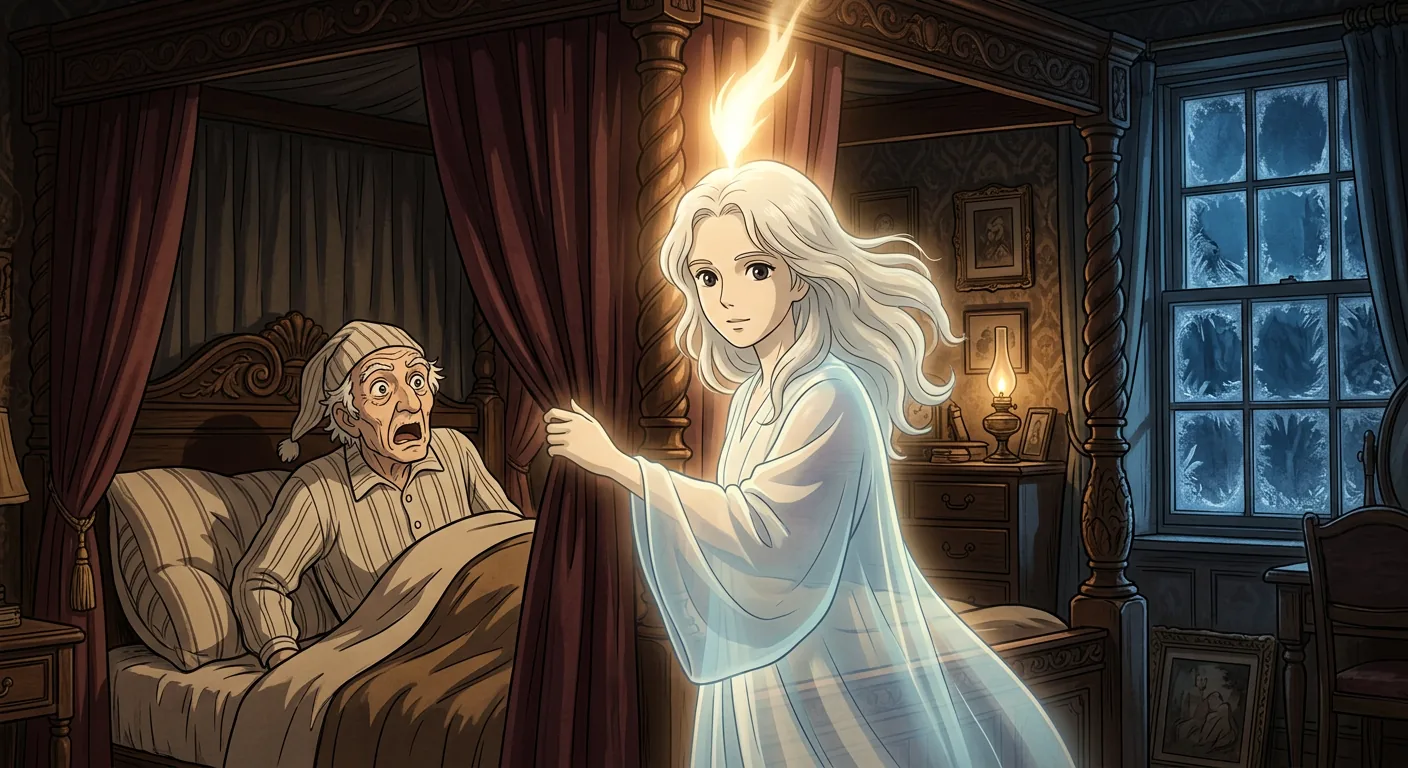
The curtains of his bed were drawn aside, I tell you, by a hand—and Scrooge found himself face to face with a figure strange beyond reckoning. It was like a child, yet like an old man viewed through some supernatural medium; its hair white as if with age, yet its face smooth and blooming with youth. From the crown of its head sprang a bright jet of light, and under its arm it carried a great extinguisher for a cap. The figure fluctuated in its distinctness—now possessing twenty legs, now a head without a body—yet always resolving again into clarity.
"I am the Ghost of Christmas Past," it declared in a voice singularly low, as if speaking from a great distance. "Your past."
When Scrooge requested the Spirit cover its light, the Ghost rebuked him sharply, for it was the passions of men like Scrooge that had forced it to wear its cap low through whole trains of years. Its business, it proclaimed, was Scrooge's welfare—his reclamation.
With supernatural power, the Spirit conveyed Scrooge to the country road where he had been bred as a boy. A thousand odours floated in the air, each connected with forgotten hopes and joys, and when the Ghost noted something upon Scrooge's cheek, he muttered that it was merely a pimple. They approached his old school—a house of broken fortunes, damp and cold—where a solitary child sat reading by a feeble fire, neglected by his friends. Scrooge wept to see his poor forgotten self, and when characters from his boyhood reading—Ali Baba, Robinson Crusoe—appeared before him, he cried out with childlike ecstasy.
The Spirit showed him his sister Fan, come to bring him home at last, and reminded him that she had died a woman, leaving behind one child—his nephew, Fred. Then came the warehouse of old Fezziwig, that wonderful master whose Christmas Eve ball filled young Ebenezer's heart with joy. When the Ghost suggested it was a small matter to inspire such gratitude, Scrooge defended Fezziwig passionately, declaring that the happiness he gave was quite as great as if it cost a fortune—and in that moment, wished he might say a word or two to his own clerk.
But the visions grew darker: Scrooge saw himself as a young man, his face beginning to show the signs of avarice, sitting beside a young woman named Belle who released him from their engagement, for a golden idol had displaced her in his heart. Finally, the Spirit forced him to witness Belle's happy family—the life that might have been his—and to hear that Mr. Scrooge sat quite alone in his office, quite alone in the world.
Scrooge wrestled with the Ghost, seized the extinguisher-cap, and pressed it down with all his force—yet the light streamed out still, unvanquished. Exhausted and overcome, he found himself in his own bedroom once more, and had barely time to reel to bed before sinking into heavy sleep, even as the second Spirit prepared to make its entrance.
A Feast of Light and Plenty
Scrooge awoke mid-snore—a prodigiously tough snore, mind you—and found himself sitting bolt upright in bed, knowing without being told that the clock was again upon the stroke of one. The previous night's visitation had taught him something, and he determined this time to meet his supernatural visitor head-on, drawing back every bed-curtain with his own trembling hands and establishing what he fancied was a sharp lookout in all directions. Now, gentlemen of the free-and-easy sort may boast themselves ready for anything from pitch-and-toss to manslaughter, but without venturing quite so hardily on Scrooge's behalf, let it be said he had steeled himself for a tolerably broad field of strange appearances. What he had not prepared himself for was *nothing*—and so when the bell tolled and no shape materialized, only a great blaze of ruddy light streaming inexplicably upon his bed, the old miser was seized with violent trembling, half-convinced he had become an interesting case of spontaneous combustion.
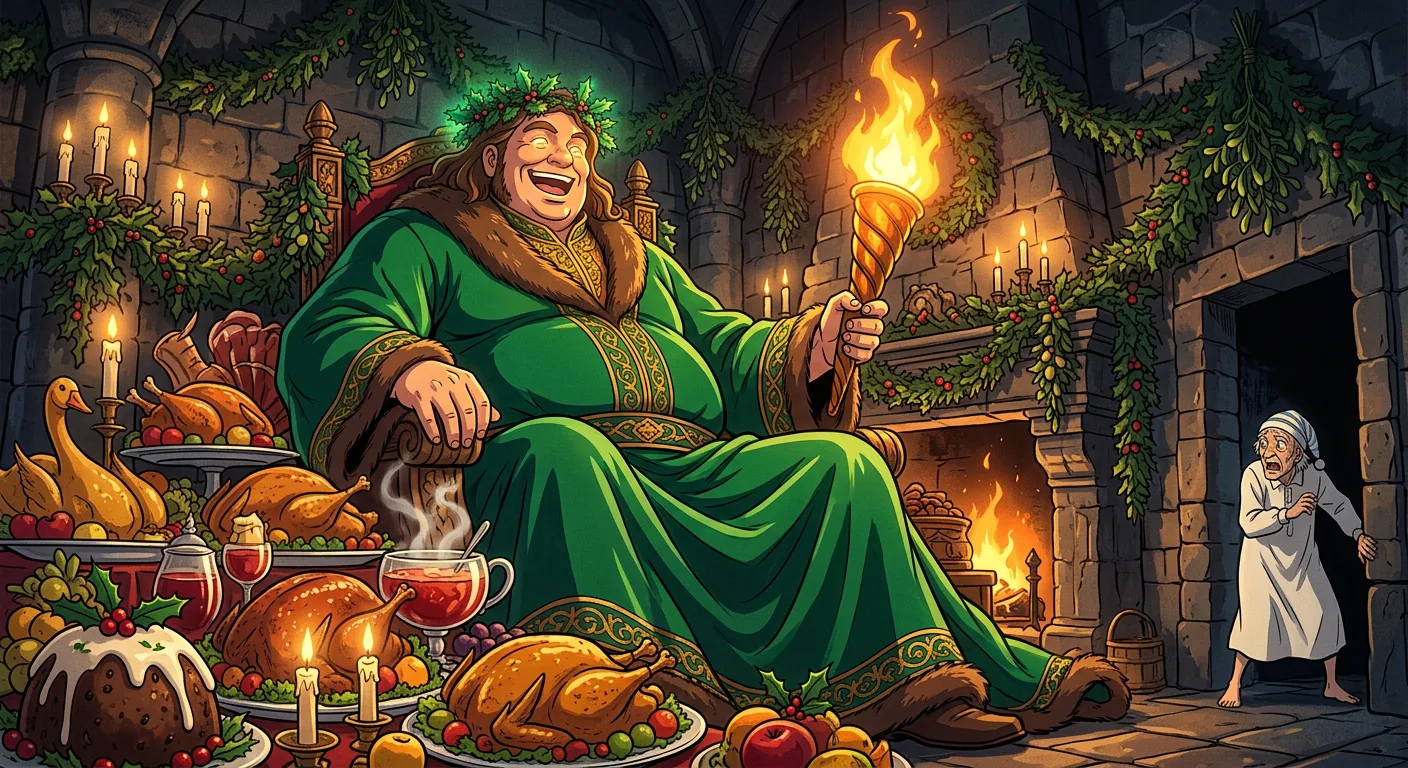
At last—for it is always the person *not* in the predicament who knows what ought to have been done—he traced the mysterious glow to his sitting room, where a voice called him by name and bade him enter. And what a transformation awaited him there! The walls hung thick with living green, holly and mistletoe glittering like scattered mirrors, while heaped upon the floor in magnificent abundance lay turkeys, geese, great joints of meat, plum-puddings, and seething bowls of punch—a throne of Christmas plenty upon which sat a jolly Giant clothed in simple green robes, his breast bare, his feet unshod, a holly wreath upon his head. This was the Ghost of Christmas Present, and he carried a glowing torch shaped like Plenty's horn, its light falling full upon the cowering Scrooge.
The Spirit revealed he had more than eighteen hundred brothers—a tremendous family indeed—and Scrooge, humbled by his previous night's lessons, submitted willingly to the Spirit's guidance. They traveled first through the bustling city streets on Christmas morning, where the people's cheerfulness defied the gloomy weather, where poulterers' shops burst with pot-bellied baskets of chestnuts and Spanish onions winked slyly from their shelves. The Ghost sprinkled blessings from his torch upon the dinners of the poor, and when Scrooge questioned whether certain self-righteous folk might close such bakers' shops on Sundays in the Spirit's name, the Ghost delivered a stinging rebuke: those who do deeds of passion and selfishness while claiming Christmas kinship are strangers to its true family.
From there they visited the humble dwelling of Bob Cratchit, where fifteen shillings a week supported a household brave in ribbons and rich in love. The family's modest goose became a feast through sheer joy, and their pudding—blazing in ignited brandy—drew universal acclaim. But it was Tiny Tim who pierced Scrooge's heart: the crippled child with his little crutch, hoping churchgoers might remember who made lame beggars walk. When Scrooge pleaded for the boy's life, the Ghost turned his own callous words against him—"decrease the surplus population"—and demanded he forbear such wicked cant until he understood what surplus truly meant and where it lay.
The Spirit carried Scrooge onward—to miners on desolate moors, lighthouse keepers on storm-battered rocks, sailors upon the heaving sea—everywhere finding Christmas warmth defying darkness. They visited Scrooge's nephew Fred, whose infectious laughter and generous pity for his miserly uncle proved that even becoming the answer to a parlor game could not diminish Fred's Christmas toast to "Uncle Scrooge." The old man found himself guessing at games, his heart growing lighter, begging the Spirit for more time.
But the night wore on, and the Ghost aged before Scrooge's eyes. As midnight approached, two wretched children—Ignorance and Want—emerged from beneath the Spirit's robes, their faces wolfish and terrible. "Beware them both," the Ghost warned, "but most of all beware this boy, for on his brow I see that written which is Doom." When Scrooge cried out for their refuge, the Spirit echoed his own heartless words: "Are there no prisons? Are there no workhouses?"
The bell struck twelve, the Ghost vanished, and Scrooge lifted his eyes to behold a solemn Phantom draped in black, gliding toward him like mist along the ground.
The Silent Shadow of Things to Come
The Phantom came upon him as silence made flesh—slowly, gravely, wordlessly—and Scrooge, though well-seasoned now in ghostly company, fell to his knees before it. Here was no jolly giant wreathed in plenty, no flickering ancient bearing light; here was darkness itself given form, a figure shrouded so completely in funeral black that only a single outstretched hand distinguished it from the night through which it moved. The Spirit neither spoke nor stirred, and Scrooge, trembling beneath those unseen eyes he felt fixed upon him, declared himself ready to follow—for he knew its purpose was his good, and he hoped, desperately hoped, to become another man entirely.
They plunged into the city, or rather the city sprang up around them, depositing them upon 'Change among merchants who chinked coins and consulted pocket-watches as they always had. Yet the conversations the Spirit bade him hear concerned not commerce but a death—some fellow gone, it seemed, whom nobody much mourned and fewer still would bury unless lunch were provided. Scrooge recognized these men; he had cultivated their esteem, strictly in a business point of view, mind you. But whose death provoked such magnificent indifference? He searched for his own shadow among the familiar crowds and found it nowhere, which gave him curious comfort—perhaps his new-born resolutions had already carried him elsewhere.
The Phantom led on, into quarters so wretched that alleys disgorged their offences like cesspools, to a beetle-browed shop where old Joe dealt in rags, bones, and secrets best left unscrutinised. There three scavengers had converged—charwoman, laundress, undertaker's man—each bearing plunder stripped from the same unlamented corpse: sleeve-buttons, teaspoons, bed-curtains torn down rings and all, and—most ghastly—the very shirt meant for burial, replaced with calico because, as the charwoman laughed, "He can't look uglier than he did." Scrooge watched these obscene merchants of death haggle over their spoils and understood, with mounting horror, that a life of avarice purchases only this: to be picked clean by strangers before the body grows cold.
The scene shifted, and he stood beside an uncurtained bed where something lay beneath a ragged sheet, dumb yet announcing itself in awful language. Cats scratched at the door; rats gnawed beneath the hearthstone. Not a soul remained to speak one kind word of the man who had died alone, frightened from human connection by his own cold hand. When Scrooge begged to see some tenderness attached to this death, the Spirit showed him only a young couple rejoicing that their merciless creditor had perished before ruining them—the sole emotion this man's passing could provoke was relief.
But tenderness existed still in the world, and the Phantom found it in poor Bob Cratchit's dwelling, where the noisy little Cratchits sat still as statues and the mother's eyes watered over her sewing—not from candlelight, she claimed, though the colour hurt them so. Tiny Tim was gone. Bob returned from visiting the green churchyard, broke down weeping, then composed himself and spoke of the extraordinary kindness of Scrooge's own nephew, who had offered help with such genuine feeling that it seemed he had known and loved the child himself. The family drew together, vowing never to forget how patient and mild Tiny Tim had been, and in their grief there bloomed a warmth that the lonely corpse on the bare bed would never know.
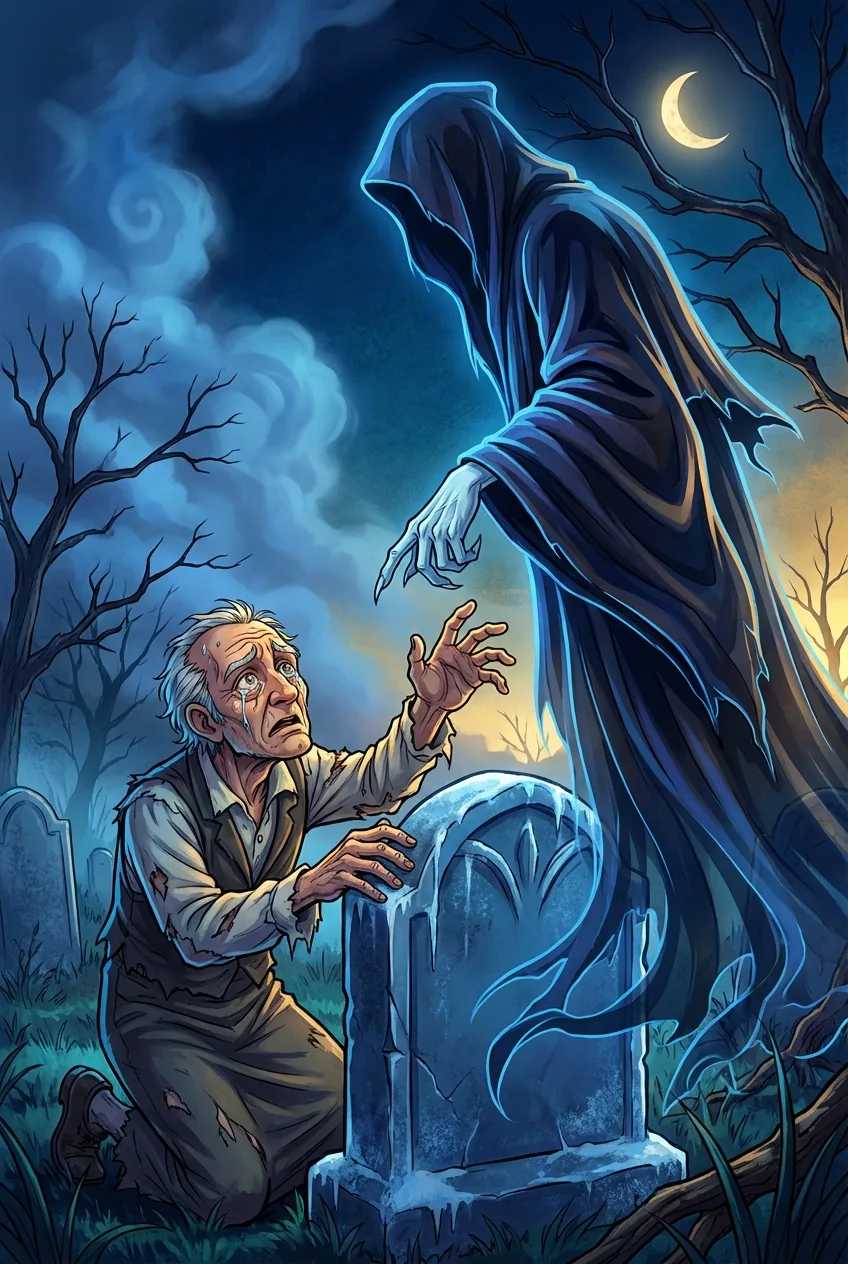
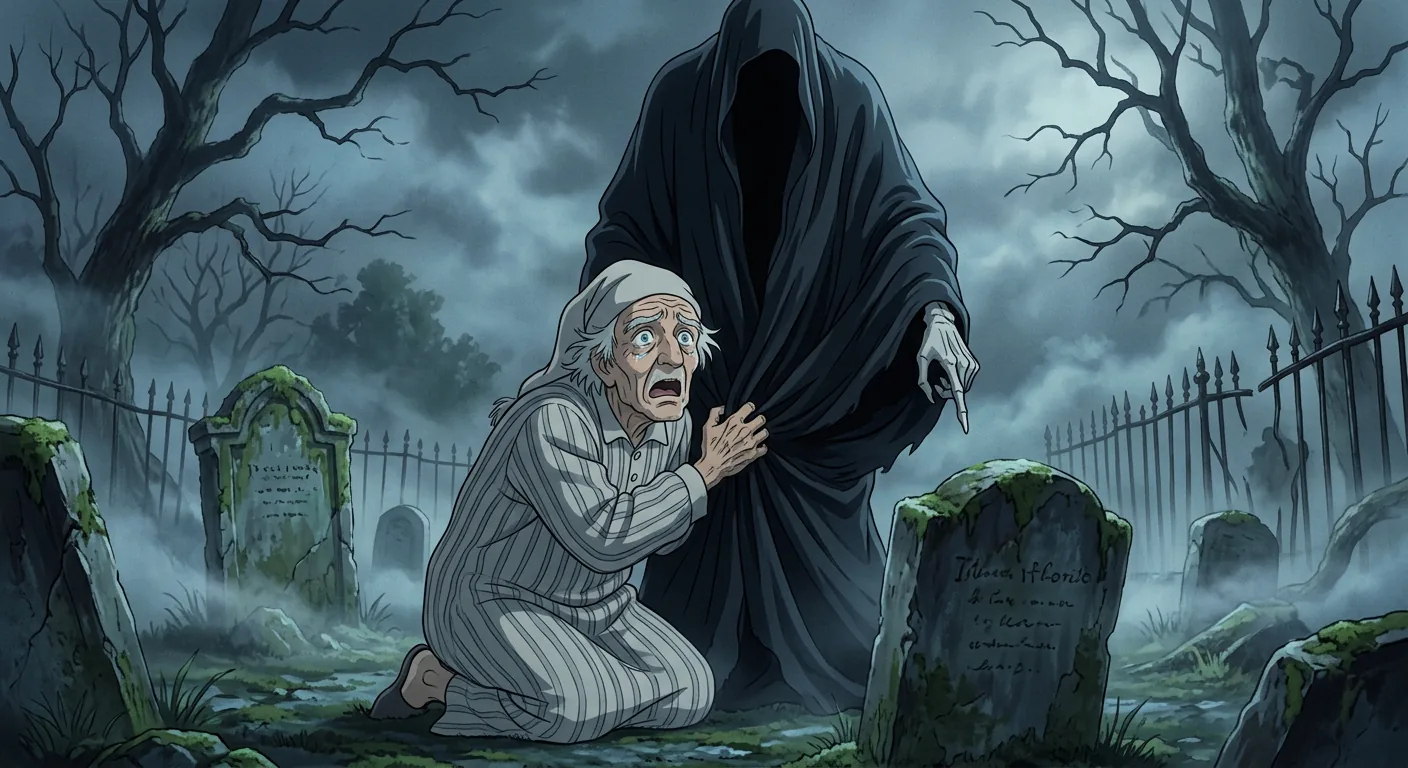
At last the Spirit brought Scrooge to a neglected churchyard, fat with too much burying, and pointed to a single stone. Scrooge fell trembling before it. "Are these shadows of things that Will be, or things that May be only?" The Spirit gave no answer. But when Scrooge read his own name upon the grave and cried out that he was not the man he was—that he would honour Christmas and live in Past, Present, and Future—the spectral hand, for the first time, appeared to shake. He clutched the phantom's robe, swearing to sponge away the writing on that dreadful stone, and as he prayed for reversal, the dark figure shrank and dwindled until it collapsed into the solid, commonplace post of his own bed—and morning, miraculous morning, awaited him on the other side.
A New Life Begins in Joy
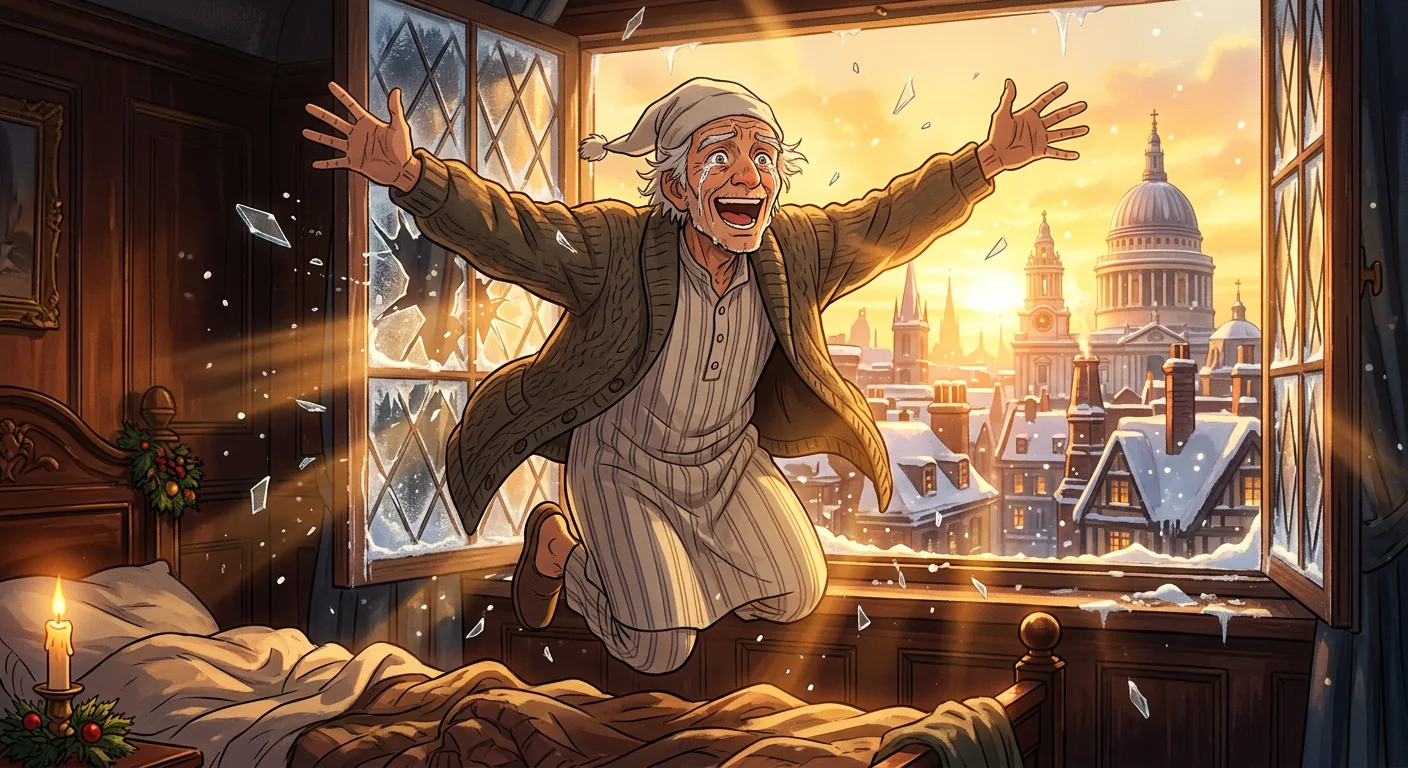
YES! — and what a syllable to hang a man's salvation upon! Scrooge awoke to find the bedpost his own, the room his own, and — best and happiest of all, mind you — the Time before him his own, stretched out like a gift yet unwrapped, ripe for amendment. The old sinner tumbled from his sheets in such a state of fluttering, glowing agitation that his garments scarcely knew which way was up, nor did he trouble himself to instruct them. He made, as it were, a perfect Laocoön of himself with his stockings whilst laughing and weeping in the same ragged breath — light as a feather, merry as a schoolboy, giddy as a man drunk on something far headier than wine.
Through his chambers he frisked — actually *frisked*, this man who had been frozen harder than his own counting-house lock — cataloguing the evidence of his supernatural visitation with all the wonder of a child discovering the world new-made. There stood the saucepan that once held gruel! There, the door through which Marley's ghost had clanked and moaned! The bed-curtains remained intact, rings and all, proof positive that those dreadful shadows of things that *would* have been might yet be dispelled. And dispelled they would be — he knew it in whatever organ now pumped warmly beneath his nightshirt.
The church bells crashed and clanged their glorious Christmas chorus whilst Scrooge thrust his head into air so golden, so piercingly cold and sweet, that the blood fairly danced. Learning from a boy in Sunday clothes that the Spirits had accomplished their entire reformation in a single night — "Of course they can! Of course they can!" — he dispatched the lad to purchase that magnificent prize turkey, the one as big as the boy himself, for anonymous delivery to Bob Cratchit's humble table. The chuckle with which he paid for the bird, and the chuckle with which he paid for the cab to carry it, and the chuckle with which he recompensed the boy were only exceeded by the chuckle with which he collapsed, breathless and weeping, into his chair.
Out into the streets he ventured, dressed all in his best, regarding every soul with such irresistible pleasantness that strangers wished him merry Christmas — sounds more blithe to his ears than any he had known. He sought out the portly gentleman he had so churlishly dismissed and whispered such munificence that the man's breath quite escaped him. He attended church. He patted children. He questioned beggars. And at last, after passing the door a dozen times, he summoned courage to knock upon his nephew Fred's house and present himself, a penitent uncle, for dinner.
Let him in? It is a mercy Fred didn't shake his arm off entirely! Wonderful party, wonderful games, wonderful unanimity, won-der-ful happiness!
Yet the culminating scene awaited at the counting-house, where Scrooge arrived early — oh, he was early there! — to catch Bob Cratchit slinking in eighteen and a half minutes late. With theatrical growling he summoned the trembling clerk, only to leap from his stool and deliver, not dismissal, but a dig in the waistcoat and a raised salary, and a promise to assist his struggling family over a steaming bowl of smoking bishop.
Scrooge proved better than his word. To Tiny Tim — who did NOT die — he became a second father, as good a friend, master, and man as the good old city ever knew. Some laughed at his transformation, but he heeded them not; his own heart laughed, and that was quite enough.
And so, having learned to keep Christmas well, Scrooge's story reaches its triumphant close — though the spirit of this tale, one trusts, shall echo long beyond these final pages, blessing us, every one.